Your Questions Answered

If you’ve been thinking about HIFU but aren’t quite sure what it involves, you’re not alone. These are the questions I get asked most often, answered honestly, simply, and without jargon.
Will my face feel firmer?
Yes. A lot of clients say their skin feels tighter and more supported rather than pulled or overdone.

What actually is HIFU?
HIFU stands for High-Intensity Focused Ultrasound. In simple terms, it uses ultrasound energy to work deep under the skin to tighten and lift. It targets layers that normal facials can’t reach, helping to improve firmness and support from the inside out.
How does it work under the skin?
The ultrasound energy creates tiny points of heat deep within the skin. This encourages your skin to produce new collagen and tightens the collagen you already have. That’s why results build gradually rather than overnight.
What is the SMAS layer I keep hearing about?
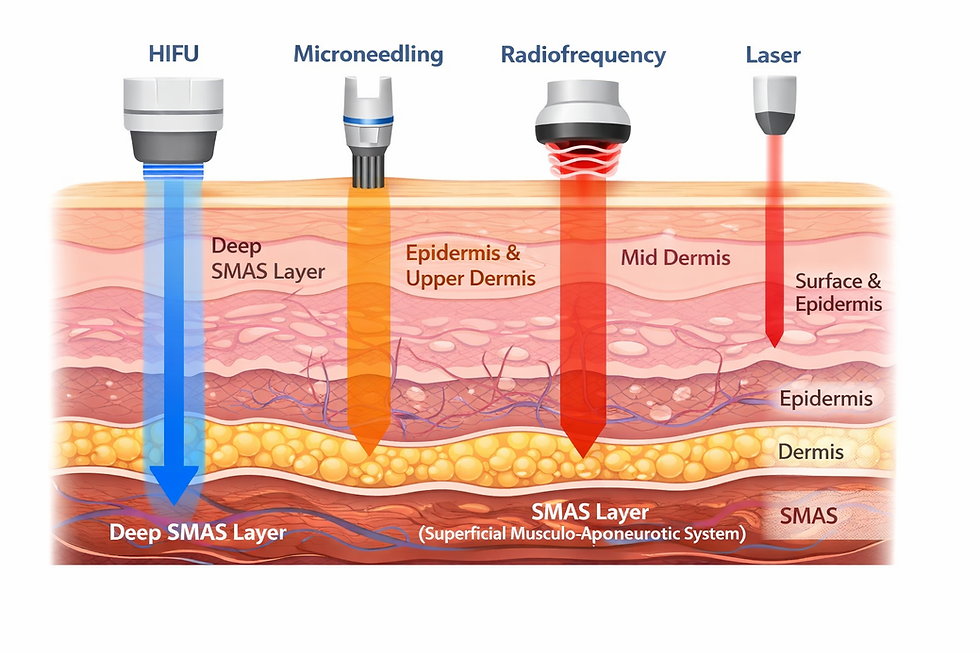
The SMAS layer is a deep support layer in the face and neck. It’s the same layer surgeons work on during a facelift. HIFU is one of the only non-surgical treatments that can reach this layer, which is why it’s so effective for lifting and tightening.

How is HIFU different to microneedling?
Microneedling is brilliant for improving skin texture, glow and fine lines because it works closer to the surface. HIFU works much deeper and focuses on lifting and firmness. They do different jobs, and when used together, they give really lovely results.
Whether you’re looking for long-term firmness, improved jawline definition, or simply want to understand your options, I’m always happy to help you make an informed decision that feels right for you.
How is it different to radiofrequency?
Radiofrequency gently heats the surface layers of the skin and is great for maintenance and regular treatments. HIFU goes deeper and gives a stronger tightening effect, which is why it’s done far less often.
Does it hurt?
Most people feel warmth, tingling and the odd sharp sensation, especially around the jawline and under the chin. Some areas are more noticeable than others, but it’s quick and very manageable. I always adjust the settings to suit you.
Is there any downtime afterwards?
No downtime at all. You can go back to normal straight away. Some people feel a bit tender or warm for a day or two, but there’s no bruising or peeling.
How long does the treatment take?
A full face and neck treatment usually takes between 60 and 90 minutes, depending on what we’re treating.
How often would I need HIFU?
Most people only need HIFU once every 6–12 months. It’s not something you have every few weeks like a facial, it’s a longer-term collagen treatment.
Why would I ever need a top-up?
If there’s more skin laxity or collagen levels are lower, a second treatment after a few months can help boost results. We’d always talk this through properly first, it’s very individual.
When will I see results?
Some people feel a bit firmer straight away, but the real results build over time. Most clients notice visible changes after 4–6 weeks, with the best results around 8–12 weeks.
Will it sharpen my jawline?
Yes, this is one of the areas HIFU is really good at. It can help define the jawline and soften the look of jowls.

What about my neck?
HIFU works really well on the neck, especially for crepey skin and loss of firmness under the chin.

Can it help drooping eyelids or bags under my eyes?
It can help in some cases. HIFU may gently lift the brow area, which can improve the look of hooded eyelids over time. Under the eyes, it can help if the issue is loose skin, but it won’t remove fat pads or fluid. This is something I always assess carefully in consultation so expectations are realistic.

Do I have to treat my whole face and neck?
Not at all. We can treat specific areas like the jawline, lower face or neck if that’s where your main concern is.
What areas can you have HIFU on?
Most commonly:
Full face
Jawline and jowls
Neck
Under the chin
Lower face and cheeks
Can men have HIFU?
Yes and it’s very popular with men, especially for jawline definition. Men just need to be clean shaven on the day so the handpiece can work properly.
What age is HIFU best for?
It’s ideal from late 30s onwards, when we start to notice loss of firmness, but it can also be used earlier as a preventative treatment.
Can I have HIFU around Botox or fillers?
Ideally, HIFU is done before injectables, or at least 4 weeks after. We’ll always plan timings properly so treatments don’t interfere with each other.
Can I still have regular facials with you?
Yes and I actually recommend it. HIFU works deep within the skin, while facials look after the surface. Treatments like microneedling, skin peels, radiofrequency, hydrodermabrasion, dermaplaning and relaxing facials help keep your skin healthy, glowing and hydrated, and they help maintain your HIFU results.
Facials are also your time to switch off, they’re where you relax, unwind, breathe, and take time for yourself. HIFU is a results-driven lifting treatment, whereas facials are very much about both skin health and wellbeing.
Think of HIFU as the foundation, and facials as the ongoing care, for both your skin and your headspace.
Why is HIFU priced at £250 for full face and neck?
This is one of the most common questions I’m asked and it’s a fair one. HIFU isn’t a facial; it’s a structural lifting treatment that works at deep levels of the skin that normal treatments simply can’t reach.
It uses specialist equipment, requires advanced training, and is carefully tailored to your face and neck. Most importantly, it’s usually only needed once every 6–12 months, not every few weeks. When you look at how long the results last, many clients find it actually replaces lots of smaller treatments over the year.
It’s best thought of as a long-term investment in firmness and structure, rather than a short-term glow treatment.
Is HIFU a replacement for a facelift?
No, but it’s a great option if you want lifting and tightening without surgery, needles or downtime.
Is HIFU suitable for everyone?
Most people are suitable, but a consultation is always needed to make sure it’s the right treatment for you and that you’ll get the best possible result.
HIFU is a powerful, non-surgical lifting treatment, but it works best when it’s chosen for the right reasons and combined with good skin care and regular maintenance.
Whether you’re looking for long-term firmness, improved jawline definition, or simply want to understand your options, I’m always happy to help you make an informed decision that feels right for you.
Vickyx

Comments